50/50 – Review

50/50 

Directed by Jonathan Levine. Starring Joseph Gordon-LevittSeth RogenAnna KendrickAnjelica Huston.

When you first hear the words “cancer comedy” your heart will probably sink and your eyes will most likely roll back: spending an hour and a half in the company of a young man who has just discovered he’s got 50% chances of dying from cancer, is not exactly anybody’s idea of a Fun-Friday-night. Also knowing that Hollywood is behind all this and that Seth Rogen (known mainly for his not-too-subtle humour) is involved in it just heightens the suspicion  that this might just be a catastrophic misstep.

However “50/50”  not only handles the cancer subject with respect, honesty and restrains but also gets the balance between both the irreverent comedy and the actual drama absolutely spot on.

Amazingly this is a film that makes you both laugh and cry within the space of minutes: the laughs may be few but they are always carefully placed to exorcise that sense of fear, angst and sorrow that runs through the rest of the movie in a way that never feels forced or gratuitous. It is funny without being flippant and heartwarming without being cheap or cheesy.

Apparently it was Seth Rogen himself who helped writer Will Reiser to cope with the disease and later pushed him to write the screenplay for the film. And this is clearly the work of somebody who’s lived through this agonising experience: there’s a certain rawness and matter-of-factness in the way the details and minutia of what must be like to live with such burden are depicted.

It’s certainly not a masterpiece (some of the secondary characters are fairly sketchy and on the whole stylistically and visually it feels more like a TV-drama than anything) but  it’s very well handled throughout and though the ending might feel a bit too conclusive and rather too optimistic (especially the bit with Anna Kendrick), “50/50” is never exploitive or cheap, it rarely pulls back and it never looses sight of the harsh reality of cancer: chemotherapy is tough, dealing with the illness is no joke for both for the patient and the people around the patient, and people do actually die.

Everybody in the film plays to their strengths and do what they do best: Joseph Gordon-Levitt in a way seems to play an extension of his character from “500 Days of Summer” (in my view one of the most refreshing comedies of the last few years): he brings with him a charming sweetness which makes him very likable and yet he does it without ever resorting to cheesy or cute winks to camera. In fact quite the opposite, as he’s willing to go that extra-mile to make it all look and feel real (he even shaved his hair in one of the most memorable scene in the film in what must have been a one-take affair). His performance is subtle and mostly underplayed and yet truthful and powerful as his character Adam moves through shock, denial, acceptance, anger, defiance. The whole movie rests on him and if the film works as it does, it has a lot to do with his performance.

Seth Rogen too, as Adam’s best friend, does his usual Seth Rogen stuff, bringing his crass humour with him and yet always rooted to some down-to-heart reality. The relationship between him and Adam is possibly the highlight of the film: never for a moment you doubt that the two of them could be real best friends.

The women in the film are slightly short-changed: the girlfriend character is under-developed and rather annoying, and the subplot with the inexperience therapist sweetly played by Anna Ken­drick feels a bit tagged on. Only Anjelica Houston manages to make the most of her slightly under-written role as Adam’s mother and shines with a couple of Oscar-worthy moments.

The music too, like the whole tone of the film, is carefully balanced, alternating a large amount with pop song (At times it almost feels like a Cameron Crowe movie) and a restrained score by Micheal Giacchino (who seems to be doing everything these days) which never falls into schmaltzy territory.

I am not sure I would want to watch this film again, nor I would be willing to suggest it to anyone who’s looking for a good day out in the cinema, but it’s a brave one and for that it’s to be commended. If only all drama-comedies were so unfussy, courageous, subtle and honest, Hollywood would be a better place.

7.5/10

04 June 2012 – in fact since writing the review above, I have watched this film again, and somehow, knowing the ending, I was able to relex more and enjoy the film even more than the first time around. (I even bumped it up by half a vote). I still feel the all-too-cute resolution with the therapist should have been cut out, but aside from that I think this is one of the strongest film that came of Hollywood last in 2011. Looking back, Joseph Gordon-Lewitt really deserved some award for this!

The Iron Lady – Review

The Iron Lady (2011) 

Director: Phyllida Lloyd. Writer: Abi Morgan. Cast: Meryl StreepJim Broadbent.

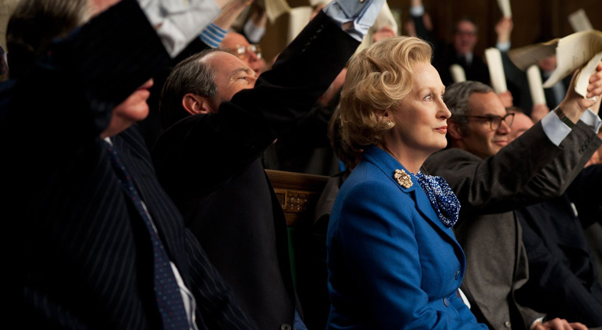
What could have been an insightful, challenging and even controversial film about one of the most loved/hated politician of the twentieth century, instead ends up being just an empty vessel for Meryl Streep to showcase once again that she’s Oscar worthy! As if we didn’t know that already… The most Oscar nominated living actress in history really does indeed become the British Prime Minister in the “Iron Lady”. Unfortunately Meryl alone is not enough to lift an otherwise flat and quite superficial biopic.

Some may argue that sometimes her performance veers slightly too much towards parody, but that’s mainly a problem with the staging and the direction of the film itself.

“The Iron Lady” is trying too hard to please everyone that in the end it just disappoints everyone. It wants to be too much like “The King’s Speech” (there’s even a scene which feels lifted directly from it, where Margaret Thatcher is rehearsing her voice… I was waiting for her to stammer at any point), but here the baggage behind the main character is just too big and edgy to get away with such lightness. Margaret Thatcher is a complex character with an even more complex life: to try to reduce it and compress it all into a film of less than 2 hours is a tough task and “The Iron Lady” suffers from trying to do it. Major events like the Falklands war, or the miners’strike,  are given just a few minutes and it all ends up feeling a little bit like reading a page from Wikipedia: yes, all the facts are there, but it all feels a little bit too superficial… And a film about Margaret Thatcher should be anything but superficial.

The film is structured through a series of flashbacks as it also try to give a more intimate portrait of the old Prime Minister in her first stages of Alzheimer. This is probably the most revealing and poignant part of the film (though not without its problems too). Once again Meryl manages to step above the mannerism and the caricature and brings some unexpected humanity into her character as the so-called iron lady becomes now more like an old rusty iron lady or worse a paper-thin weak old woman (with the aid of some impressive make-up. The people behind the make-up in J.Edgar should watch and learn!!): her performance as an old woman is something to wonder at!

However the film doesn’t quite know what to do with all this material and all the characters around Mrs Thatcher. Are we supposed to like this controversial and yet influential British politician? Are we really meant to feel sorry for her? What is it try to tell us by showing the Iron Lady as a weak old woman stricken by illness? It’s all rather too easy to be controversial, and too thin to be thoughtful, too friendly to be considered seriously.

In the end all we are left is a marvellous performance for a film that doesn’t quite deserve it.

6/10

War Horse – Review

War Horse (2011) 

Directed by Steven Spielberg. Starring Jeremy IrvineEmily Watson, Niels ArestrupPeter MullanDavid ThewlisBenedict CumberbatchCeline Buckens.

CONTAINS SOME SPOILERS

War Horse has probably some of the best Spielberg we’ve seen in a while, but unfortunately it has some of the worse too. The result is a strange hybrid of a film that at times showcases true mastery in Film-making (some real craftmanship that very few directors have these days) but other times falls flat (and almost into self parody) with some incredibly misjudged moments and, worst crime of all, (especially for a Spielberg’s film) is actually devoid of any real emotional drive: each set piece works as an individual piece in itself, but as a whole film “War Horse” lacks a certain narrative unity which in the end prevents one for getting completely swept away despite the glorious score by John Williams.

I was ready to let myself go on this one: on paper this is the ultimate weepy! But strangely while I was left admiring the nicely composed frames and the beautiful cinematography, I found myself emotionally detached from the actual story. Whatever happened to that great manipulator of emotions that still makes me cry every time I watch ET? Why was I so underwhelmed and not reduced to tears as I should have been?

Spielberg films his horses just like he would film a human being: close-ups, tracking shots and all sorts of filmic tricks bring them alive as their faces turn to camera and their eyes reflect the light from yet another great vista. He’s so good at making us see what the horses are actually feeling at any point in the film, that he almost forgets to make us care for the actual human beings the populate the rest of the film.

Human characters come and go in this film like bell boys in a hotel and yet few of them really leave any mark. Rarely you really feel sorry for these people when they die (crucially some of them die off camera too!), maybe because they’re so many of them, or maybe because most of these are slightly two-dimensional or maybe because there isn’t enough time to get close to them (However look at  Pixar’s “Up”: we were all crying during that 5 minutes montage scene!). Let’s face it, the real star of the film is the horse and that’s it. We don’t really care about the humans…

I’ll give you an example: At the end of the film (watch out… spoiler ahead) there’s a big reunion moment between our hero, Joey, (and his horse) and his family. It’s supposed to be a bit climatic moment, as the music swells and the cinematography pays tribute to Gone with the Wind itself. The old parents are finally able to hug their son who’s just returned from war. Potentially this is a heartbreaking moment unravelling under our eyes and yet I was coldly thinking to myself: “Oh… I didn’t realise the parents were actually worried and waiting for him… because I’ve never actually seen them being worried while the kid was away. In fact I don’t think I ever even seen the kid being in difficulty during the war. Was he suffering? Was he missing his parents? All he seemed to care about was the horse, and that one seems fine to me”. How could that be the big climatic moment of the film, if I wasn’t really prepared for it by anything I’ve seen so far.

And what about all those people dying? Was I meant to feel something for them? I really didn’t, because I was only given the point of view of the horse. It looked like I was only meant to care about the horse.

Are we all basically just supposed to feel sorry for people dying, simply because they just… erm… die, even if the film hasn’t really made care about them?

The beginning of the film is probably the worst part. It’s a very lengthy first act, which despite continuous nods to Spielberg’s intellectual mentors like John Ford (just to mention one) feels cheap, corny, cheesy, slow and just dated in the worse possible sense. Spielberg may call it old-style film-making, but those words actually disguise some pretty bad and indulgent sequences, with some caricature acting that makes it all look more like a bad episode of “The Little House in the Prairie” than “How Green Was My Valley”.

Especially considering what’s coming later on, this first part feels like a totally different film. It is all plastered with a constant unsubtle soundtrack, without a single moment of silence, that tells us what we are supposed to think at each given point. Worst of all are the more comical-moments in this first part, which are really unfunny and yet the music make them sound almost as if they belonged to a Lauren & Hardy film.

But just when you think this is getting so predictable and really beyond bad, finally war breaks and the film becomes something completely different, and actually quite good one.

This is the best Spielberg of the best moments Saving Private Ryan (and to a degree the one behind the scenes of both Band of Brothers and the Pacific). There are hints of his genius popping up every few minutes

There are some absolutely beautifully and impeccably crafted and choreographed sequences: some thrilling battle scenes, some great memorable moments (a massive crane reveals the aftermath of a battle and shows us that the casualty of war are not just humans. An execution sequence, seen through a windmill chilling in its beautifully timed production), there are some breathtakingly locations, some wonderful cinematography, and of course a heartfelt score by John Williams (more successful here where it has more time to breathe than it did in Tintin.

One of the most beautiful scene which obviously everyone will remember is when our horse gets trapped in big cluster of barbed wire (amazing special effects by the way. Surely that must have been some CGI work, though I couldn’t quite tell how it was done) and then is saved by two soldiers from two opposite armies: it’s an almost poetic moment which gets away from being panned as a cheap trick and manages to be funny, sad, poignant and tense all at the same time.

There are some great new characters too peppered throughout and there will be moments to leave anyone speechless for their powerful honesty and epic scope.

But unfortunately, despite all these elements and all these little stories, the overall arching narrative  still feels bitty and choppy and even though what’s actually happening under our eyes is so powerful that we could almost forgive anything, the ultimate emotional journey of the main human character, Joey, is not as strong or compelling as the sum of all the other parts and eventually I couldn’t quite connect to him.

What we are left with is a very uneven film which wants to reach everyone (never the terms “a film for the whole family” has been more appropriate and I’m sure everyone will enjoy if not love parts of it) and yet I can’t quite help feeling that if it hadn’t tried so hard to please everyone it probably would have been a stronger film. There were moments I loved and moments I really hated, and if my rating may seem a bit high is probably because after 3 weeks since i saw the film, those great moments in it are still imprinted in my mind.

7/10

J. Edgar – Review

J. Edgar (2011) 

Directed by Clint Eastwood. Written by Dustin Lance Black. Cast: Leonardo DiCaprioJosh HamiltonGeoff PiersonNaomi WattsJudi DenchJeffrey DonovanDermot Mulroney

I am finding really hard to find something good to say about this latest dull dull dull film by Clint Eastwood. I am actually even beginning to think that it’s probably time for Clint to enjoy his retirement, instead of giving us every year a film which borders between the cheesy, the flat and most crucially the rhetorical propaganda! I am sorry to say this, because I love the guy as a person, but let’s face it, both Invictus  and (especially) Hereafter were real stinkers

As far as J. Edgar is concerned behind the thin patina of gloss, the actual true fascinating story and an impressive cast, there is otherwise very little to enjoy.

Eastwood directs it all almost by numbers, as if he wasn’t even there, without any visual flair, any care or attention for details, any subtlety, or  worse any real ideas or anything to say.

Every decision behind the making of this film seems to have been wrong one: the decision to break the film up, flashing backwards and forwards makes it too complicated to follow and keeps the audience emotionally detached for at least the whole first half. The decision to allow Eastwood to recycle his usual plain piano notes soundtrack, which sounds exactly the same as every other one of his films and actually here is used in the most cheesy possible way to its worse effect. The decision to have J Edgar Hoover telling the story of his life to a biographer (my God, can it all be a bit more obvious please!?), but most crucially, the decision to have Di Caprio & Co acting with (not very good) prosthetics for half of the film thus forcing the audience to get constantly distracted by the bad hair lines, the dodgy fake wrinkles and the rubbery feel on people’s faces. I must have spent half of the film looking at the make-up thinking “God, this is bad” and even when sometimes I though “mmm, this is a bit better…” I was always aware of it. Even when you look at the publicity stills from the movie (the picture above this review) you can see tell how fake the hairline is. In an age of seamless CGI (look at the ageing effects of Benjamin Button!!) I am surprise to see such shoddy  work (hopefully it’ll look alright on DVD, but on the big screen I saw this, digitally projected, it all looked incredibly ropey).

I am usually a huge fan of Di Caprio: I loved him since  “A Boy’s life” when he upstaged even Robert DeNiro (in a time where DeNiro was actually still good), he was absolutely amazing in “What’s Eating Gilberg Grape” (to this day one of my favourite films), I thought he was one of the most mesmerizing Romeo in  Baz Lurhman’s “Romeo + Juliet“, I even liked him in Titanic (in fact, I think, special effects aside, some of the success of that film was because of his ability to draw us in.. and to draw millions of little girls back to see the film over and over again). He was great in the Aviator, the Departed and he even managed to bypass the fact that he had a baby-face in both Catch me if you Can and Revolutionary Road, just because he was so good in both! But on “J.Edgar” Di Caprio is forced to spend half of the film covered in that damn thick prosthetics which prevents him to convey any real emotion to his character. I felt like I was always watching Di Caprio in a fat-suit as opposed to J.Edgar.

To be completely honest, it’s not all his fault. Eastwood ‘s direction jumps from scene to scene, sometimes quite randomly, trying to cover as much ground as possible from the undoubtedly intriguing real life. There are way too many characters, too many story lines, most of which are left hanging without a real sense of place and eventually the emotional focus of the film gets diluted and any understanding of his character gets lost.

There are some potentially very strong moments: for example the relationship between J.Edgar and his domineering mother (the always very watchable Judi Dench) and the sexual tension between Di Caprio and Armie Hammer, are both potentially very strong, however in the hands of Eastwood they all fall into schmaltzy and clichés as those cheesy piano notes tell us “a now, watch out… this is going to be emotional”. It’s all handled so badly that it even kills a potentially good performance like the one by Di Caprio.

The rest is just a hollow mess where characters come and go without leaving any real mark: we never really know why Naomi Watts‘s character decides to stick with J. Edgar right until the end, we never really get a grip on the procedures that made finger prints database possible, we never really get a sense of what could have happen if the real J.Edgar had been exposed and while all sorts of lawyers and politicians appear and disappear in a seemingly random succession we are getting more and more lost in irrelevant subplots.

It could have been a fascinating story: a closeted gay, the first director of FBI, a man who lived through presidents like Truman, Kennedy and Nixon. There could have been so much here and yet it’s all wasted in bad storytelling, staging and wrong choices at every turn.

I blame the direction, the script (surprisingly the same person who had penned the quite gentle and a lot more subtle Milk),but also the editing: obviously a lot has been cut out trying to condense 50 years into 137 minutes. But instead of loosing entire subplots and deciding to make it all more focused, somebody made a terrible decision to actually have it all in. The first 20/30 minutes are some of the most disjointed and messy I’ve seen in any film recently.

It would probably deceiver even less than a 5/10 rating, but some of central performances are quite good, despite everything else around them.

5/10

The Girl with the Dragon Tattoo – Review

The Girl with the Dragon Tattoo (2011)

Director: David Fincher. Writers: Steven Zaillian. Cast: Daniel CraigRooney MaraChristopher PlummerStellan SkarsgårdRobin Wright

Your appreciation and enjoyment for  this film mainly comes down to whether you buy into the story or not and whether you are you a fan of the original book (I should probably say books, since this is the first part of a trilogy). Unfortunately my answer to both questions is quite a drastic no: I know I am going to be quite unpopular with this statement, but I’ve never really fallen in love with the book and I in fact just don’t seem to be able to  find the appeal for the actual story itself. I find it quite derivative, exploitive, contrived and a bit heavy-handed to be honest. These exact same problems are translated (in fact even enhanced) into both film adaptations.

It’s probably unfair to draw comparisons with Niels Arden Oplev‘s 2009 version, but also unavoidable. There are of course similarities, but given the fact that David Fincher is directing, the US version is a lot more slicker and cinematic. It is also closer to the original book in many places, but, as always in condensing it all into a movie, it has lost some of its more polemical thrusts from Larsson‘s story and some of the details which made the characters so compelling. All for the sake of the actual crime/mystery plot (which let’s face it, it’s pretty bland for today’s standards and brings very little new to the genre). So in the end, not only the film suffers from the same problems of the book but by shrinking it all it has lost some of its more subtle subtext too.

I am not really saying anything new here: what works in books doesn’t necessarily work movies. For example, the film spends a long time setting up the two main characters who don’t meet until a good hour and 20 minutes into the story. And yet despite all this time Daniel Craig‘s character is just as elusive to the audience as it was at the beginning. That is an ongoing problem with Fincher’s movies. His usual cold approach to film-making and detachment from his characters makes it always very hard for anyone to empathise with anyone on the screen. Craig does bring some unexpected charm and a slight sense of humour to his character (something which was completely absent in the previous version), but it’s really not enough to make you care for his character, let alone for making you want to watch him again for the next couple of sequels (Fincher has recently announced his interest to direct both sequels back to back… But no official announcement will be made until this one get released, of course).

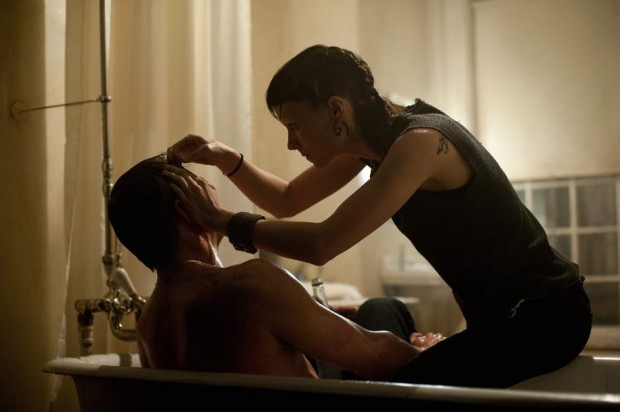
It’s Rooney Mara who really steals the show here (well, let face it, so did Noomi Rapace in the previous version. It’s a great part to play!). This is one of the performances of the year and there will certainly be nominations and awards for her coming left and right over the next few months. She even manages bring a certain realism to an otherwise over-the-top character by convey both fragility and an incredible strength, sometimes with pure simple looks.

However, did we really need that 1 hour and 20 minutes of preparation before these two characters meet? Did we really need to see the infamous rape scene? Yes of course, it’s that rape that gives her the motivation for wanting to solve the crime, but why couldn’t they just convey that with a quick flashback? Why was the audience allowed inside that room watching not only the rape but also her revenge to her rapist? Wouldn’t it have been just as effective and less exploitive if we had been left outside the door, maybe listening to the screams?

The problem is, if you take all that preamble out of the equation, you’re actually left with very little else because let’s face it, as a mystery this is a fairly derivative film.

As I said, these are all queries with the book and the story itself . Given the material Fincher has probably down the best he could. This is a handsome film, with some solid acting (Plummer once again is at his best!)  but in the end you’re left with a sense of “…so what?”.

I couldn’t help feeling that everything that Fincher did in this film, he had already done it before.

The dark tones of Se7en, the seedy  and multilayered atmosphere of Zodiac, the dark ominous  music (if we can call it that) by Trent Reznor from  The Social Network.

Finally it’s probably worth mentioning the impressive “James Bondesque” title sequence (again, Fincher has down beautiful title sequences before) to the notes of the cover version of  “Immigrant Song” by Led Zeppelin which I found absolutely mesmerizing and yet somehow seemed to belong to a different film altogether.

In the end this film adds very little to the previous version, aside from giving us the wonderful Rooney Mara, and certainly adds nothing to what I already know about David Fincher. I just look forward to seeing him handling a script and a story worth of his craft, because I do believe he’s one of the best directors out there right now…

6.5/10