Cosmopolis – Review

Cosmopolis (2012) 

Directed by David Cronenberg. Starring Robert PattinsonJuliette BinocheSarah GadonMathieu AmalricPaul GiamattiSamantha Morton.

How can anyone enjoy such a self-indulgent pile of unintelligible garbage is really beyond me. A few years ago I used to think Cronenberg was one of the most inventive directors around in America: his early films, though not very accessible in a mainstream sense, have always been at least incredibly imaginative and created some images of nightmares of an almost visceral quality, which would stick in our minds for years and years to come: whether it’s an exploding head (Scanners) or a TV screen literarily eating your head (Videodrome), or piece of ears and fingernails falling off Jeff Goldblum  decomposing body  (The Fly). Even the non-completely successful  Naked Lunch or eXistanZ despite their absurdity, were intriguing enough to keep you glued to the chair and had ideas and inventiveness to fill not just one but two films. And then Crash, of course, I film I really hated  and yet I cannot deny its power.

More recently David Cronenberg seems to have abandoned his visceral style for one which is more cerebral… and his nightmarish images have been replaced by tedious logorroic dialogue and by doing that he’s really lost me… It was only a few months ago that his spectacularly dull A Dangerous Method was released. A film that not only managed to bore the hell out of my me, but which also made Michael Fassbender look quite a banal actor: quite an achievement indeed. But if you thought A Dangerous Method was slow, talky and un-cinemtic, Cosmopolis will go you even further and take you to unexplored corners of boredom and self-indulgness, like few films have done before! How could Philip French from the Observer have called it “riveting cinema” is a real a mystery… Are you kidding me?

I would be willing to bet that if the film had been made by a different unknown director, (and not starred Pattinson) hardly anyone would have even noticed it, let alone raved about it as some people are doing.

There are possibly one of two interesting ideas about the film’s concept, which all come from the novel by Don DeLillo, from which the film was adapted: the journey of a multi-bilionarie crossing New York inside a limousine to have a haircut (yes, that it is).

Whether you read Cosmopolis as a premonition for the economic crash or simply as the descent of a man into bankrupcy, there is no denying that this film is one of those clear examples of an adaptation that should have really stayed on the written page of a book. Because once the cumbersome dialogue gets transposed onto the screen, it really begins to show how proposterous and self-indulgent it all is. And unfortunately that’s all the film has to offer: dialogue dialogue, dialogue… and more dialogue. I have nothing against films built around dialogue and speeches (12 angry men is a masterpiece and that takes place inside a room where people talk at each other!). The problem here is that the dialogue in question is so full of itself , so obtuse, so preposterous, so un-real, so arty, and just so uninteresting, that after a while it really starts to go through you, as opposed to you. While watching this film I literarily found myself wondering “What is it they’re actually saying to each other?!”.

Beyond the dialogue, there’s very little else to admire in this film. The cocoon-like atmosphere inside the limousine is not supposed to be real, but it’s jarring at the best, it’s distracting and after about 5 minutes it becomes just tedious. The multitude of characters that come in and out of the journey, all seem to live in some sort of limbo, and despite their obvious differences, all talk with the same monotone voice those uninteresting lines of dialogue. So much so that it’s actually impossible to tell whether anyone is good in this film. I’m sure they are, because they’re all great actors… Sadly, their skills is totally wasted here. Lots of people asked me: “How is Robert Pattinson? Is he good?”. Well you know what? I have no idea? Mainly because that part is playing is so dull, so unreal, so uninteresting, so un-engaging that after a while not even the charm of Twilight-icon is enough to carry you through.

I’m all in favour of film directors trying new things, experimenting with cinema, trying to follow their personal paths, but when it comes to pointless crap like this, they should really spare us from joining their egocentric selfish trip!

This is an insult to all those Pattison fans out there and a deadly kick on the balls to all of us common mortals who happen to stumble across it. They should really pay us to watch this kind of stuff and it should not be the other way round… (actually I might ask Philip French to pay my ticket!).

Stay well away from it, for your own sake. Let’s not encourage Mr. Cronenberg to pull any of this shit on us again!

4/10

The Amazing Spider-Man – Review

The Amazing Spider-Man (2012)  4.0_MG_SMALL

Directed by Marc Webb. Starring Andrew GarfieldEmma StoneRhys IfansDenis LearyMartin SheenSally FieldIrrfan Khan.

The Amazing Spider-Man ⭐️⭐️⭐️⭐️

With the latest “Spider-Man: no way home” on its way, what better excuse to revisit some of the old ones
When the news of a reboot for the Raimi-Maguire Spiderman was first announced (and not just a reboot, but another ‘origin’ story, only 10 years after the first one), the obvious question on anybody’s lips (and mine too) was “Why on earth?”.
What followed was a sort of anti-campaign from fans and critics alike: it was as if we had all already decided we were going to hate this film, at all costs.
Well, I could not have been more wrong: The Amazing Spider-man is a lot fun, feels fresh, and deserves a lot of more credit that it’s had over the last few years, but more importantly Andrew Garfield was just a wonderful Spiderman (something I never thought I’d say at the time, as I loved Maguire in his previous films): he even has a couple of Oscar moments here and there (not that The Academy would ever reward a superhero movie…). This is probably the film that made me like Garfield for the first time.
The comparison with the previous incarnation of “your friendly neighbour”, especially since we are meant to buy into another ‘origin story’ so soon after the first one, is not just unavoidable but also quite fair.
The ghost of Raimi is constantly behind the corner, but cleverly director Mark Webb (who has obviously studied his source deeply and intensely) managed to avoid most of the obvious comparisons by giving the story a completely new spin (pardon the pun), steering away from anything which could give us any sense of Déjà vu, making the story and the characters different enough at each opportunity, giving us a new baddie and most importantly a new girlfriend too.
In fact, what really makes this film work for me, despite all the action, the spinning, the spectacle (and the film has a lot of that!), is the relationship between Andrew Garfield and Emma Stone: their chemistry is undeniable (Yes, I know those 2 were actually together at the time) and it’s the real heart of the film. I love watching them.

Three editors are officially credited and that’s usually a sign of a film that’s gone through several permutations, and some of those tweaks and reshuffles were apparent to a slightly trained (and nerdy) eye like mine. For example despite the 136 minutes, some of the transitions were a bit too quick: the explanation of how Parker was able to make his web seems to be those sequence that suffered more than any others.

Also, James Horner‘s score felt a bit too saccharin/syrupy and much too stirring in what should have been quieter and intimate moments, but more crucially, it seemed to lack that Hero-theme which these types of films require. The kind of theme you can still hum by the time you leave the theatre, just like when you watched the original Superman or Indiana Jones (God, is John Williams really the only composer who’s able to do that?).

But I know, I am really picking needles here! This might not be the most original story you’ve ever seen (well actually it’s definitely not but at least they spared us from seeing the ‘origins’ all over again in Tom Holland’s films!), but it’s still a thrilling romp and thoroughly enjoyable one too.

4 Stars (out of 5)

Killer Joe – Review

Killer Joe (2011) 

Director: William Friedkin. Cast: Matthew McConaugheyEmile HirschJuno TempleThomas Haden ChurchGina Gershon.

I came to this film knowing very little about it and pretty much spoiler-free (which incidentally it’s always the best way films should be watched). However I was very aware of the director Friedkin‘s pedigree and having seen all those 5 stars flashing on the poster, I was building myself up for something really good, if not a masterpiece.

Unfortunately the film left me not just cold, but actually rather annoyed by how uneven and all-over the place it all was. In the end I just can’t help but be baffled by the critical response that it’s gaining.

It won’t take you long to realise what type of film you’ve stepped into and you’ll be able to tell straight away this is certainly not one for everybody and especially not one for the Matthew McConaughey‘s hard-core fans (who are there anyway?!): within the first 30 minutes of the screening I was in, I watched at least 4 different couples standing up and leaving the theatre.

The people depicted in the film certainly don’t belong to your typical American family. You know the ones I mean: the loyal husband kissing goodnight his lovely wife in her nightgown, always looking as if she’d just stepped out of a 2 hour beauty session and all together having a lovely meal around a dinner table… These are people who don’t really talk to each other, but rather  “at” each other: they shout, swear, lie. They’re happy to plot the murder their own mother, or their own ex-wife, willing to let their own daughter to have first time sex with a stranger in order to pay what they can’t afford to buy.

Friedkin doesn’t shy  away from showing you not just the worst side of everyone, and certainly there is no sugar-coating around any of the depiction of the characters. Just to give you an idea of what I am talking about, let me tell you that the first shot we get of  Gina Gershon, introducing her character as she opens the door to her son-in-law in the middle of the night, is an uncompromising view of her private parts. We get it straight away.

The film indeed did leave me with a quite uncomfortable feeling right form the word go, but not so much because of this approach, of the unlikable characters, or grim subject matter, but more because of the way the actual story was all being handled by the director. I couldn’t quite work out how I was supposed to take all this.

On one hand it was clear that Friedkin was talking about that “America” we rarely get to see in movies: shockingly ignorant, naive, violent and brutal. And while this doesn’t certainly make a pleasurable viewing experience,  I was very willing to go with it. I was constantly being reminded of films like The Killer Inside Me and yet there was something slightly off about Killer Joe. There was something fake about it: at times the characters seemed to be over-the-top caricatures of themselves: hard to like (of course), to care about and more crucially to believe in them.

It was at least 40 minutes into the film that the  audience I was with, started to laugh. Call me thick, but only then I began to realise that all this was actually to be taken as a satire.

Of course, the Killer Joe Cooper himself  is at times is filmed like a character from a comic book, and yet other times the camera lingers on him for very long takes, giving the film a much more grounded sense of reality.

But this is a long step away from the harsh realism Friedkin‘s previous masterpieces, like The French Connection and to a degree even The Exorcist, which despite the absurdity of its story, always treated its subject matter with so much respect  and honesty that it actually felt incredibly real (which is what made the film so powerful).

What we have in Killer Joe is a weird and uneven hyper-version of reality: and we as the audience are left to watch it from the outside, as you’d probably watch some kind of freak show.

But this isn’t another Natural Born Killers,  Killer Joe constantly shifts (especially in the first part) from real to almost parody and even slapstick (the joke with the jacket, however funny, seems to belong to a different film). Some people may argue that this is called “being subtle” and it’s what makes Killer Joe a masterpiece, I personally call it being “all over the place” and eventually found it very hard to digest.

Don’t take me wrong, I am not against satirising violence or ignorance: the Coen Brothers did it in Fargo with splendid results, but while in Fargo there was no fudging, just a perfect unity of tone right from the start, here I couldn’t help feeling that this was a film made by different people pulling in too many directions. All the subplots to do with Emile Hirsch‘s character (which is incidentally the most under-developed in the story) belong to one kind of film, while Thomas Haden Church (who once again plays an idiot) belongs to a different one, and of course Matthew McConaughey seems to have his own show all together.

It all comes together into a final act which is (intentionally) so over-the-top that it cannot leave you but completely baffled. The audience I was with went absolutely wild as if they were watching Airplane! or a Naked Gun movie, which leads me to think I am certainly in the minority of those people who didn’t find it all that funny. It’s a completely personal thing, I understand, but I find it quite fun to laugh at what’s essentially rape… Whatever the message underneath might be.

The episode with the Kentucky Fried Chicken leg will probably remain imprinted in your head for years and years to come, and it might even become as classic moment in cinema as the Royale with Cheese speech in Pulp Fiction; it’s certainly a non very subtle visualisation of the message the film is trying to carry, but to be honest at that point I had already lost my patience and when the ending finally came, as abruptly as it did, I was as happy to leave the theatre as I have rarely been. Was I offended? Not particularly. That would give the film more credit that I’d like to give it. I just thought it was all a bit pointless.

5.0/10

Friends with Kids – Review

Friends with Kids (2011) 

Directed by Jennifer Westfeldt. Starring: Jennifer WestfeldtAdam ScottJon HammKristen WiigMaya RudolphChris O’DowdMegan FoxEdward Burns

Making a good romantic comedy is not as easy as you might think. Comedies in general  have always been the overlooked genre when it comes to recognition or even awards: there is a certain (unfair) snobbery about them and an even greater misconception: because they talk about lighter subjects than, let’s say, the holocaust or war or cancer (just to mention the few obvious ones), we should not consider them as serious films…  Obviously calling them “rom-com” doesn’t quite helped their case either…

Isn’t it incredible that people still look at the 50s and 60s for the favourite comedies (Some like it Hot or the Apartment)? Or that we still quote those classic Woody Allen movies from the 70s? And when asked about the best rom-com (there you, I’m saying that too!) many will go back 23 years to that little jewel of a movie called When Harry Met Sally. It’s not surprising then to see writer/director Jennifer Westfeldt going back to exactly those types for her directorial debut.

Friends with Kids owes a lot the best Wood Allen (nowadays we must specify ‘best’, as there’s good Woody and dreadful Woody), both in its settings (New York, of course) and in the sharp and witty dialogue exchanges. But there are lots of echoes from When Harry Met Sally too, in fact it could almost be called “When Harry and Sally had a kid“. But while in Rob Reiner‘s classic the question was “Can a man and a woman be friends without sex getting in the way?”, in Friends with kids the question gets updated to “Can a man and a woman have a child, without getting stuck into the trappings of married life?”.

The actual premise and the excuse for the film is definitely rather out-fetched, gimmicky and to a degree it might feel a bit forced, but if you’re willing to go with it, what you’ll find beyond is an incredibly well-observed and smart piece of comedy about the painful truths of parenthood, about getting older, about responsibilities and friendship.

Westfeldt relies more on her characters and their dialogue to make us smile, or cry, or simply think, as opposed to resorting on cheap gags, or shots of cute babies (well OK, you get a couple of those too… But you get my point). This is an actors’ film, first and foremost and the cast is truly impeccable.

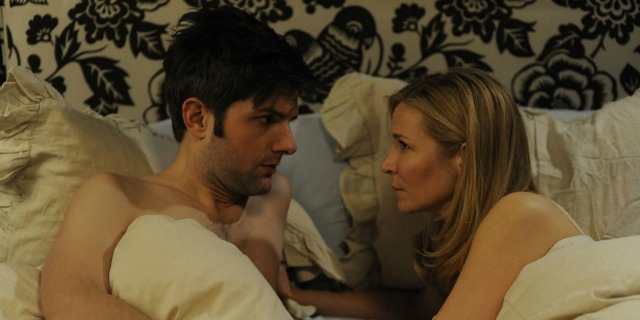
Adam Scott had already shown what he could do with the underrated (and rather harsh and depressing) HBO series Tell Me You Love Me: in this film he makes a potentially unlikable and tricky character, warm, sympathetic and charismatic.

However the film is also packed with other characters, which once again remind us of Harry and Sally’s types of friends: these are all people rooted into the real world, instantly recognizable to anyone struggling to find love before the clock runs out, anyone dating, anyone who’s been married for a long time, anyone who’s had kids or who’s about to have some. Like in the real world, there’s no black and white here: each relationship in the film feels true, people are not simply bad or good, they fall in and out of love, they come and go in and out of your life.

Everybody is perfect, even if they just appear in a few scenes. Jon Hamm shines, as he always does, and makes the most of his tiny role, even Edward Burns manages to be incredibly likeable and there’s even a surprisingly turn from Megan Fox, who shows she’s not just a pretty face… and body, and legs.. and… OK well, you get it.

It all comes to a head during an excruciating dinner sequence with no less than 8 people sitting around a table, which is not just beautifully directed and skilfully handled, but also it’s where the film really shows its cards and goes beyond the simple rom-com boundaries.

It’s interesting to see this film only a few weeks away from the clichè-riddled What to Expect When You’re Expecting. Both stories essentially tackle the same issues, but while WTEWURE goes for the easy Hollywood way (i.e. schmaltzy, A-list packed-cast, cheap jokes and so on), this one takes its time to work around its characters and aims at reaching a much more mature audience: it’s not just the situation that feels real but way the characters behaves in that particular situation.

Unfortunately there are some slips here and there: the excessive and unnecessary vulgarity of some of the dialogue does feel a bit forced and some jokes to do with kids seem to belong to a different kind of film (It’s “Three men and a Baby” territory, more than Annie Hall‘s)… And the ending might make some people cringe a little bit… However most of Friends with Kids is so honest and balanced that it feels wrong be harsh about it. In an age where good romantic comedies are so rare (they only come once every two years, if we are lucky!) we should treasure films like these, which at least try to be a little bit more intelligent and step away from the clichés of the genre.

7.5/10 

Check out my review of What To Expect When You’Re Expecting

Ill Manors – Review

Ill Manors (2012) 

Director: Ben Drew. Cast: Riz AhmedEd SkreinNatalie PressAnouska MondLee AllenMem Ferda.

This is a very hard film to review… And as a matter of fact it was a very hard film to watch too. More than once I found myself having to look away from the screen, just to be able to catch up with my breath and I had to remind myself “It’s only a movie… It’s only a movie”… Or is it? Sure one would want to give the film some credit for attempting to talk about some really serious issues in a stark and crude realistic way. However I find myself wondering: just because a movie touches important issues and goes to places where many don’t even dare looking, does that make it a good film?

Ill Manors (still trying to work the meaning of the actual title) is clearly a film made by a first time director: it’s full of energy and ideas. It’s inspirational too… But  unfortunately some of the inexperience shows up on the screen too. It’s almost as if director Ben Drew didn’t feel confident enough of his own material and felt he had to pepper the film (unevenly, I may add) with a series of flashy visual devices: some of them work, but then, once the story takes over, the film almost forgets to keep up with them. It makes me wonder if Ill Manors could have been a much more powerful film, if the director had actually restrained some of that rather showy visual style and un-linear editing and had just concentrated more of the story. I’m not against time-laps or montage sequences edited to rap music (some of which were actually beautifully done), but I think once you establish a style, you should stick with it. In Ill Manors everything felt rather random and arbitrary: a hotchpotch of visual ideas and devices, borrowed from many other films before (Pulp Fiction and Trainspotting, just to mention the most obvious ones), but all without any real reason. And the proof is in the pudding: the strongest and most interesting bits in the film are also the plainest and the ones where the director focused just on his actors (or actually non-actors apparently) to tell the story of a broken society alive and well right in the heart of London.

Despite the claims of realism, this bleak vision of Britain feels a bit contrived in places: lines like  “Can I try some crack?” the endless prostitution scenes and the final sequence in particular when a fire takes place in a pub, all feel a bit heavy-handed and wildly exaggerated. Also most of the characters are a little bit too stereotypical and the film seems to rely more on the charisma of our main lead, Riz Ahmed (from Four Lions), for the audience to sympathise with, instead of giving him a full fleshed-out and a much more believable persona.

In the end the amount of horror and depressing bleakness is just too much and what was already a fairly long film, with too many subplots, eventually just imploded. An exhausted audience during my screening even burst into laughing during the final climax (yes, it might have been a hysterical laugh, but still a laugh… and that’s just the wrong reaction to have for such film!). The points  Ill Manorswants to make are made quite earlier on and after a while it all becomes just too repetitious, over the top and indulgent. All this makes it loose its edge and diminishes its important message.

It is a brave film and certainly must be commended for trying: there are some very intense and good moments, which I am really praising, however, even though I might talk to people about Ill Manors, I don’t think I’ll ever reccomend anyone to watch it (aside for our prime ministers and politicians).

6.5/10

Sunday Times (June, 10th)

For all its gritty realism, Ill Manors has a streak of sentimental fantasy to it. It’s one thing to suggest that the char­acters aren’t all bad, and that they are capable of moral virtue(…) But when we see an uncaring thug risking his life to save a baby from a burning building, we have left the mean streets of London for the fantasy world of Hollywood. So much for keeping it real.