Submarine – Review

SUBMARINE (2010) 

Directed by Richard Ayoade. Starring Sally HawkinsPaddy ConsidineNoah TaylorCraig RobertsYasmin PaigeGemma Chan.

Early review at recent festivals (Including Sundance and Toronto) have been quite positive on this small Welsh Independent film, which feels so much like a cross between Wes Anderson and Spike Jonze: in fact, it has indeed been compared to Rushmore, but also you can’t help seeing in Craig Roberts something from Dustin Hoffman in the Graduate.

I was less taken by it. On one hand it’s the sort of film I really want to like (Mainly because it’s been founded by the now gone British Council, but also because it’s always refreshing to see a little Indi trying to make it among those big Hollywood monsters), however I just couldn’t help feeling that not only I’ve seen it all before, but that behind the sporadic bittersweet and quirky humor, it all felt a bit too cold and calculated and in the end it was just very “gray”, just like that Welsh weather.

There are good individual isolated sharp moments, but the pace of film as a whole feels completely off. It is very self-indulgent (those moments with the 8mm footage for example, outstay their welcome) and you can’t help feeling a strange discrepancy between the  fast witty humor from the script and the actual staging of it. The film is patchy and uneven: from the very misjudged soundtrack (the score does not match the pictures nor the dialogue on the screen and the songs didn’t always work for me),  to the way it’s been filmed (very real at times but very stylized in other places). Finally, editing wise, it was too slow when it should have been faster (somewhere in the middle for example), and too fast when it should actually have been slower: the whole subplot with the parents at the end seems to resolve too quickly, for example. In fact the whole ending felt like it had been attached at the last moment and it’s too sweet and clean for this type of film.

The stuff around the kids is works a lot better than anything to do with the parents. The portrayal of the uncomfortable teenager feels quite accurate, honest and, despite the not-always-necessary voice over, somewhat poignant too. However beyond that, there were too many caricatures too, who contributed to the uneven feel I had at the end: Paddy Considine’s character was way too cartoony and the moments with his top speeches were clearly other examples something else which definitely could have been trimmed a bit.

On a silly side -note, I really didn’t like the titles at the front and the typeface of the captions in general… But that’s just a question of taste I guess.

On the whole “submarine” is an interesting yet flawed debut film but I’m looking forward to see what Ayoade does next.

6.5/10

Ironclad – Review

IRONCLAD (2011) 

Directed by Jonathan English. Starring James PurefoyKate MaraBrian CoxPaul GiamattiJason FlemyngMackenzie CrookAneurin Barnard.

Blood does run indeed in one of the most brutal in-your-face violent Brit-flicks (and not just British to be honest) I’ve ever seen.

In fact it’s the violence itself that seems to be Ironclad’s selling point. It’s obviously all sold as “realism” but we all know that in this case it’s just another word for gratuitous and exploitive.

And so as the handheld-shaky-cam swings about and the editing goes crazy hiding the pretty low-budget, limbs fly left, right and centre, hands get chopped off, people get literally sliced in two in the bloodiest and ruthless gore-fest you’ll ever seen.

To be honest with you, after a while if you just go with the silliness of it all, you might actually even enjoy it a bit. I think I did,  despite the never-ending 121 minutes.

But in its defense, to be able to stretch what’s essentially one long battle for 2 hours is quite an achievement.

The story of Ironclad, after a very dodgy (though mercifully short) intro/opening which seems has been lifted straight out of a bad docu-drama, is indeed very simple: a small group of 20 people or so try to protect Rochester Castle (Apparently a pivotal garrison in England) against a siege by King John’s army. That’s pretty much it. Don’t expect much else in terms of character development, or plot twist, or story, or even lines of dialogue: in fact most of the dialogue consists of a series of aaaaaaaaarrrrrrhhh and rrrrroarrrrr and other stuff like that. However compensating all that, you’ll get  a lot of stabbing, slicing, hammering, catapulting and all type of swordplay and fights.

And the choral soundtrack makes it all feel even bigger that it is.

Paul Giamatti is probably the most absurd miscast of the year so far and yet, aware of that himself, he ends up having great fun with the role and plays it so over-the-top that you just can’t help but laughing with him.

All the other actors too give their best with their one-dimensional characters.

Incidentally the whole audience I was with laughed out-loud at the ludicrous ending too, in fact perfectly in keeping with the rest of the film, which at least doesn’t take itself so seriously like Russel Crowe’s latest Robin Hood.

What can I say? I will never watch this film again, but while I was there I had fun with it (if only it had been 20 minutes shorter I might have liked it even more…)

6/10

Animal Kingdom – Review

Animal Kingdom (2010) 

Directed by David Michôd. Starring Ben MendelsohnJoel EdgertonGuy PearceJacki WeaverJames FrechevilleLuke Ford.

This is a really tough watch… And yet, it isn’t the violence itself, because actually there’s very little of it, but the constant sense of eerie dread and tension that permeates the whole film and makes it almost unbearable to sit through.

Some of the most violent acts happen all of a sudden (hence even more shocking), towards the beginning of the film and take you completely by surprise and then, in the words of writer-director Michôd, “you’re just left with the aftermath”. Supposedly that’s how violence is in real life.

It’s a clever device that throws the audience right off-balance from the start. From that moment onwards, we know we can expect anything at any moment. So the idea that something could happen at any point is more distressing than the violence itself.

That is the most successful aspect of”Animal Kingdom”, a film that otherwise threads through a well know pattern and feels like many other crime films.

But forget the jokey Tarantino of Pulp Fiction, or the epic almost-romantic Coppola of the Godfather, this is a serious crime film, and it feels real!

“Animal Kingdom” is a drama at every turn and twist and it depicts the lives of a family of criminals in Melbourne. Obviously it all benefits from having a series of (very convincing) performances from actors who don’t carry the burden of recognition.

Right from the start we are catapulted in the middle of it and it’s up to us to work out who’s who. I did confess I was a bit lost in the beginning and took me a while to actually be able to recognize all the characters. Also I didn’t think the main character (James Frecheville) was particularly interesting to watch: his face is pretty much black for most of the film, which I suppose is the point of the film (his mother dies right at the beginning and he doesn’t even flinch) and yet this detachment he didn’t make him particularly sympathetic and in the end I thought that was an error in judgement.

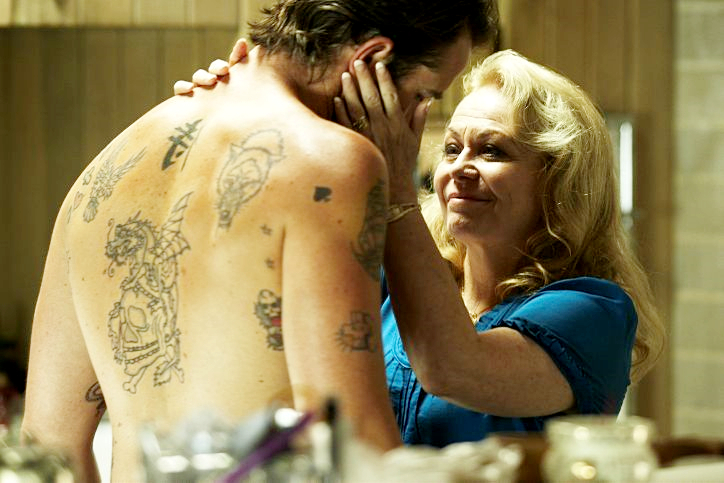
As the film unfolds, slowly we begin to see how terrifying these people (animals) really are, even the most innocent looking ones: the figure of the mother, Smurf, played by Jacki Weaver is one of the scariest creation I’ve seen in a long time. On the surface she’s a small, gentle, smiley mother who gives full-mouth kisses to his sons, but behind all that, hides the pure evil (witness a wonderful scene in which she asks for her own grandson to be killed).

Her Oscar Nomination for supporting actress is truly deserved.

Behind the (artificial) sense of reality, Michôd uses every trick in the book to make it feel cinematic at the same time : the slow-motion as people walk towards camera, the long elegant tracking shots (reminiscent of Scorsese’s early gangster’s films) and finally the music itself

As if the subject matter wasn’t tough enough, Sam Petty’s ominous score rumbles along through the subwoofer (that “.1” from the 5.1 surround sound) in a series of prolonged low monotones, which you almost feel in the stomach and make those tense sequences feel even more dangerous.

The only oddity, which I didn’t think was needed at all, and adds nothing to the film, is the use of voice over at the beginning and at the end (especially coming from a character as blank as J). In fact, generally speaking, the script is the most un-remarkable thing about the film.

When it all finally ended, I was gagging for some fresh air and I couldn’t wait to go outside in the freezing cold London of these days and breath with relief

This is by no means a criticism to the film, in fact quite the opposite: it’s the proof that the film worked for me. Having said that, I wouldn’t want to call it entertaining or  want to watch it again, but I’ll certainly look out for what Michôd will do next (hopefully with a more original story).

7.5/10

Howl – Review

Howl (2010) 

Directed by Rob EpsteinJeffrey Friedman. Starring James FrancoMary-Louise ParkerJon HammJeff DanielsTreat WilliamsDavid StrathairnBob Balaban.

I went into “Howl” really wanting to like it. Maybe because I had heard it was a film that tried to do something different, or maybe because I’ve always liked Allen Ginsberg’s poetry or maybe even because in the last few months I have started to think James Franco is one of the most interesting new actors around.

On paper this sounded like the dream film for me. However, leaving the theatre I couldn’t help feeling a sense of disappointment for the failed attempt that it is.

In the end “Howl”  is just a bit of a mess… I can now see why it took so long to be released here in the UK (they’re probably hoping to cash in on the back of James Franco’s notoriety with 127 Hours).

The film is essentially a biopic, not of a person, but of a poem (That by itself is a pretty new concept). How did the poem came about, when it was written and the controversy it caused… And obviously the poem itself.

The directors Rob Epstein and Jeffrey Friedman, are mostly known for their documentaries The Times of Harvey Milk and The Celluloid Closet. In fact this film too was originally intended as a straight documentary. The decision for the change was due to fact that apparently there is very little material  of Ginsberg himself as a young person, during the time Howl was conceived.

This a certainly not a very conventional film: apparently every word and every scene has been drawn from existing material, whether from interviews, accounts, articles, court transcripts and so on. It follows several different strands and jump through several timelines. A real collage of different stories each with their own different style, pace and music and all put together sometimes in a seemingly random fashion: almost like a film within a film… within a film.

There are several different sides to the film.

There’s Ginsberg himself, beautifully and carismatically played by James Franco, as he’s being interviewed by a faceless reporter. This section has a sort of late 60s look in its greenish-tinted color However as he talks about his life, there are flashbacks to his life, all filmed in black and white. These are the ones who feel more superficial, even though are potentially the most interesting one and certainly the most cinematic ones. Unfortunately they’re too sporadic, too brief and the constant interruption and voice over  somehow alienates its audience and makes it really hard to emotionally engage with any of it. In the end, I can’t help feeling that this part only really scratches the surface.

The other layer in the film is the obscenity trial which in 1957  tried to ban the publication of the poem and prosecuted its publisher. This is the most straightforward part of “Howl”, filmed like a court room drama and focusing on the arguments between the prosecutor (played by David Strathairn) and the defense lawyer (Jon Hamm), though the testimonies of a series of  mainly pompous and prejudiced witnesses from Jeff Daniels to Mary Louise-Parker. It is in a way the most engaging and interesting part of the film too also it shows you how far away that 1957 now is.

Finally, there’s the poem itself: some of  which is performed by James Franco in a club to a group of people in complete awe, but most of it is depicted with semi-abstract animated pieces peppered throughout the movie.

This is the more “showy” part of the film and the most “arty” too (in the worse sense of the word) in my view.

There’s a line at some point in the film, during the trial where somebody says “Sir, you can’t explain poetry, this is why it’s poetry”. Well, the film-makers should have probably listen to their own script a little bit more carefully and follow the advice.

The moment the poem is visualized the film fails as it limits it, shrinks it and trivializes it.

In the end the James Franco is the saving grace of the “Howl”. The blend of styles and the several strands of story are just too ambitious. The film feels over-crammed with things and I can’t help thinking it would have worked a lot better if the film-makers had chosen a simpler way to tell the story, without succumbing to arty devices.

6/10

You Don’t Know Jack – Review

You Don’t Know Jack (2010) 

Director: Barry Levinson Writer: Adam Mazer Stars: Al Pacino, Brenda Vaccaro and John Goodman, Susan Sarandon

This wasn’t an easy watch, I have to tell you. More than once during the long 134 minutes (according to imdb, or 164 according to my SkyBox) I thought of stopping the recording and quitting the film before the end.

I was an absolute wreck throughout and I must have lost the count of the times my eyes were so watery that I couldn’t even see the screen anymore. But in the end the film is so skillfully done, beautifully acted, well paced and gripping that I couldn’t turn it off.

It is one of the most powerful film I’ve seen in the last few years, one that touches a subject that still divides the world: euthanasia.

I am extremely happy I saw it, but I don’ t know if I could do it again.

Oscar winner Director Barry Levinson has obviously got an agenda and the film is by no means impartial, and yet it never feels heavy-handed and in fact by the end, there’s still a lot of room for discussion.

The music, for example, is used sparingly and whenever is there, it doesn’t feel overdone.

The deaths of the people in the euthanasia scenes are quite detailed and intense to an almost unbearable level, especially at the beginning of the film: But once you get the idea of how the whole process works, after about 30 minutes or so, the “assisted suicides” become less graphic and they begin to happen more and more off-camera, though respectfully they’re always signaled by  a caption with the full name of the person who’s just died.

That makes you always very aware you’re watching something real, something that has actually happened. Consequently it makes it even harder to watch. However the film is never exploitive.

Of course, if you really wanted to pick it apart, then you would probably argue that there isn’t enough time given to the opposite side of argument. Only a few sound-bites are given to the protesters and the prosecutors are very sketchy characters,who are only seen arguing their cases during the court cases; however mercifully they are not caricatures and we never laugh at them (which would have been terribly manipulative).

There are some lighter moments here and there and I did find myself laughing at the dark and surreal humor, but, on the whole, given the subject itself, this is pretty serious stuff and there’s not a lot to laugh about.

On paper this could have become the cheesy, typical TV-movie-of-the-week: and yet “You don’t know Jack”  has that Quality (with a caption Q) we’ve all become to expect from a HBO production over the years: the direction, the photography, the editing, the script and of course the acting!!

First and foremost Al Pacino, who truly gives one of the best performance of his life  and within the first few minutes completely disappears inside the role of  Jack Kevorkian.

He shows us the best of him and the worst. He wants to help, he’s compassionate, he’s got principles and he has guts, but he’s also an arrogant, sometimes vicious and not necessarily a nice man. He’s also a reclusive man who hardly shares his feelings with anyone (hence the great title “you don’t know Jack”).

The supporting cast is great too, from the ever-wonderful John Goodman, to Susan Sarandon.

In the end whether you agree with Kevorkian’s practices or not, it is hard not to be compelled by this movie. Whether you react positively or negatively to it will probably be tainted with personal views about assisted suicide rather than the film’s actual merits. But since this is still an ongoing dilemma, it’s great to see a film exploring the issue so well. It’s interesting that they choose to do it as a TV movie as opposed to for the big screen: it makes you think whether America is actually ready for the debate… (and don’t tell me, the manipulative, “Million Dollar baby” did it before).

9/10